
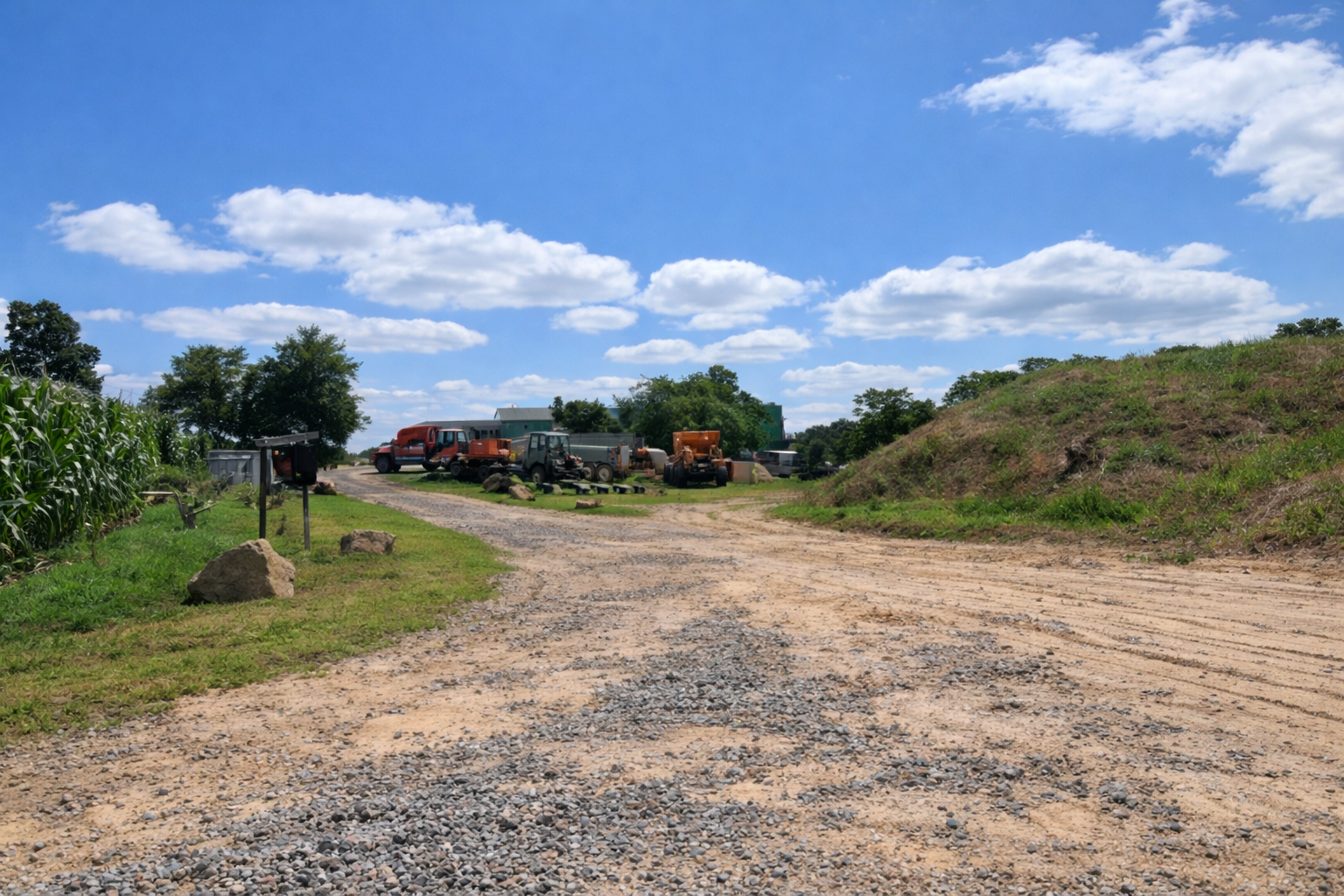
Frederick Road - Clean Energy, Cultivated Locally.
At Lightstar, we are committed to building a sustainable future through collaboration and shared purpose. By adopting solar energy, homeowners and communities gain the ability to reduce rising electricity costs, enjoy stable and predictable energy prices, and achieve lasting peace of mind. Our solar solutions are more than just a step toward energy savings—they're an investment in a resilient, connected community. By choosing renewable energy, we all take meaningful action to ensure a greener, healthier planet for generations to come.
Societal & Environmental Benefits


Savings to local LMI residents annually TBD
1500 Metric Tons Removed
In 1 year, this project avoids 1500 metric tons of CO2. This is equal to avoided greenhouse gas emissions from:

3.4 million Miles Driven (average gas powered car for 1yr)
Project Overview
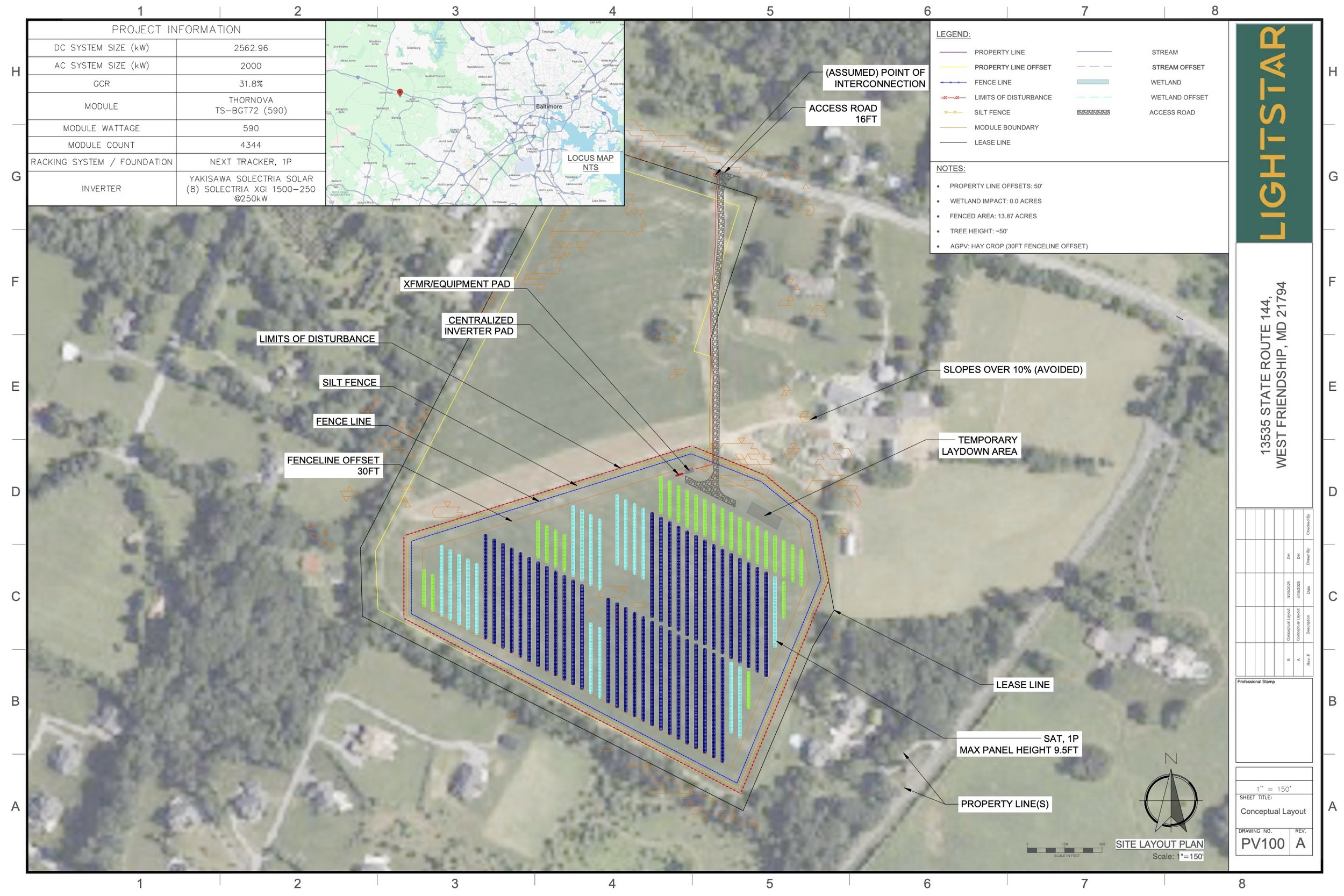
The Frederick Road project is a proposed 2 MWac (2.562 MWdc) community solar array located in West Friendship, Maryland. Designed as an agrivoltaic (AgPV) system, this initiative generates clean, renewable energy while actively maintaining the underlying land for agricultural use.
Once operational, the Frederick Road array will generate enough electricity to power approximately 350 local homes year-round. Through the local BGE community solar program, the project delivers lower energy bills directly to county residents and low-to-moderate income (LMI) customers. By combining renewable power generation with active farming, we are supporting local grid resilience and preserving valuable agricultural land.
Agricultural Integration
We designed the Frederick Road array to ensure the land remains in active agricultural production throughout the lifespan of the project. The 13.87-acre fenced footprint features a 30-foot fenceline offset and wider spacing between panel rows. This specific layout easily accommodates the safe movement of standard farming equipment, including trucks, trailers, tractors, mowers, tedders, and balers.
The site will actively support a hay crop and allows for livestock grazing alongside and underneath the solar panels. To guarantee the success of this dual-use model, Lightstar partners with industry experts:
Solar Agricultural Services (SolAg): SolAg bridges the gap between solar developers and farmers, providing deep expertise in agrivoltaic management to ensure the land thrives.
American Farmland Trust (AFT): As a national partner of AFT, Lightstar actively commits to the Smart Solar™ initiative. We work collaboratively to scale agrivoltaics nationally and protect the lands farmers steward.
Environmental & Community Impact
The Frederick Road project provides a powerful environmental benefit to the West Friendship community. The array abates roughly 1,500 metric tons of CO2 equivalent every year. This clean energy generation equals the removal of 3.4 million miles of internal combustion engine car travel from our roads annually.
Beyond clean energy, the project delivers deep community and economic benefits:
Farm Preservation: The reliable rental income allows the landowners to supplement their current agricultural operations, offering long-term financial stability and helping preserve their family farm legacy.
Ecological Protection: Field studies confirm the project design avoids protected wildlife, aquatic features, and results in zero wetland impacts.
Community Respect: Lightstar utilizes strict best management practices to protect the surrounding environment. While standard inverters create some sound, we ensure noise levels remain below local thresholds at the property lines, with zero sound emitted at night.
Temporary Footprint: The project involves no permanent changes to the land. At the end of its operational life, the equipment will be fully decommissioned, and the property will be completely restored to its original state.
Frequently Asked Questions
At Lightstar, we are committed to transparency and collaboration with the communities we work in, and we value addressing questions and concerns from local residents, landowners, and stakeholders. Below, we’ve provided responses to the inquiries regarding our solar development project to ensure clarity and open communication.
Our approach to solar development is future-focused and rooted in urgency to decarbonize our grid. We work collaboratively with landowners, local communities, and town officials to create projects that reflect best practices in sustainability, foster economic opportunities, and align with shared long-term goals.
We remain committed to maintaining open communication with all stakeholders and appreciate the opportunity to address these thoughtful questions. Should you have additional inquiries, we encourage you to reach out so that we can continue fostering a transparent and productive dialogue.
-
Andrea’s Farm is a 54-acre diversified agricultural operation specializing in raising cattle and cultivating hay, soy, and corn. The agrivoltaic solar array proposed by Lightstar will feature 2.562 MWdc / 2 MWac, Single-Axis-Tracker panels on 18 acres, with rows of panels spaced to fit farm equipment. This project integrates hay and cattle grazing under the array, while allowing the tenant farmer to continue soy and corn harvesting elsewhere on the property. A proud partner of American Farmland Trust, Lightstar has a proven track record of developing solar agricultural projects, prioritizing land stewardship, sustainable practices, and long-term partnerships with farming and community partners.
-
Maryland is rapidly losing family farms to permanent commercial and industrial development. This project will support a legacy family farm for decades with stable income and sustained agricultural production on the property. As an agrivoltaics project, Lightstar is compelled by statute to remain in agricultural operation per the COMAR Title 18 Agricultural Use Assessment. Failure to do so carries severe financial penalties. Lightstar, the landowner, and the farmer are all aligned and incentivized to keep the land in production with exceptions for extreme weather, crop failure, or drought – just as every Maryland farm is required.
Howard County’s agricultural business and farming is the fifth largest economic driver in the state, contributing more than $200 million annually. Agrivoltaics provides additional revenue streams to family farmers – in addition to revenue of the crops, the farmers are paid to maintain the vegetation (crops or forage) within the project area. Many family farms Lightstar works with, uses this financial stability to reinvest in their farming operations, often expanding it.
In addition, the project will generate clean energy for approximately 300 local homes combined with sizeable grid investments to improve resiliency. The project will also generate significant county tax revenue, aiding public services and community programs. Furthermore, Lightstar will hire Maryland-based firms for engineering and construction, creating local jobs, and supporting the economy.
-
Lightstar and consultants have prepared an erosion and sediment control plan and will comply with MDE/Howard County’s stormwater management and construction requirements. Implementation of construction-phase best management practices (BMPs) such as silt fencing, stabilized entrances, and inspection/maintenance procedures will be in place to ensure compliance. Through an aquatic delineation study, it was determined the project has no effect on any surrounding streams, wetlands, stream buffers, or regulated floodplain areas. Lastly, a threatened and endangered species habitat study, cultural resource investigation, and forest conservation review have all been completed and determined the solar project has no adverse effects.
-
Lightstar has worked over the last five years with Solar Agricultural Services (SolAg) to support our farmers through the transition to agrivoltaics farming, but perhaps the most important scope of work that SolAg provides is oversight of soil protection measures before, during, and after construction. SolAg has overseen 160MW of solar construction on prime farmland for the purposes of agrivoltaics. With the guidance of SolAg, this project will follow best practices for installing solar on agricultural land and will include training of construction workers on these best practices prior to the commencement of installation. Those practices include pre-seeding the land, establishing a soil-building cover crop prior to construction to prevent erosion and compaction, and separating topsoil from subsoil when excavating for buried conduit, so that the topsoil can be put back on the top +/-1ft of the excavated trench. Additionally, LSR will be limiting construction vehicle and equipment travel via dedicated access roads and work zones to prevent unnecessary soil compaction across the site. Additionally, dedicated staging area for construction trailers and material preparation will be established in a suitable area away from the day-to-day operations of the farm. If necessary, at the end of construction this staging area can be disced for the purpose of decompaction. In the area of the array, in keeping with good agricultural management practices, soil decompaction will be performed if necessary following racking and panel installation.
-
Because this is an agrivoltaics project, Lightstar will be preserving the soil onsite through development, construction, and operations. Lightstar is working directly with the Maryland Department of Environment Storm Water Division to avoid unnecessary grading of soil and disturbance to the prime soils on site. At the same time, the project will likely be improving runoff conditions on the property since solar is held to a different standard than agriculture in terms of stormwater. Contractors will follow soil and water best practices when installing the array including minimal to zero site grading, ensuring that topsoil stays in place or is added where needed, minimizing soil compaction, and inspecting equipment regularly to ensure tight seals and to prevent fluid leakage. Once in operation, the farm will follow agricultural best management practices outlined by and in consultation with the United Stated Department of Agriculture’s Natural Resource Conservation Service (USDA-NRCS). Whenever possible, regenerative soil health practices such as vegetative buffer strips will be planted to decrease potential for sheet flow which can cause erosion.
-
Lightstar will design the 7-foot fence and planted landscape buffer, so they don’t “pinch off” or dam the site’s existing natural drainage paths based off mapped flow routes (swales/low points/ditches/culverts). If the fence must cross a drainage feature, it would be detailed to maintain flow (minimizing grading/trenching in the flow path). Drainage infrastructure is proposed along the access road and near the site entrance in the form of a bio-retention pond.
-
Lightstar will be working with a local tenant farmer that is obligated to keep the project in active agricultural production per state regulations, ensuring that this farmland stays preserved. Lightstar is compelled by the COMAR Title 18 Agricultural Use Assessment process to maintain the land in state-approved agricultural operation on an annual basis. Lightstar takes compliance with this activity very seriously, as non-compliance includes a significant penalty. The site plan approval will include the agricultural operation as part of the vegetable management plan.
-
The site will be accessed off State Route 144, for which we will attain a MDSHA driveway/entrance permit. For the on-site access road, we are attaining the necessary Howard County grading/stormwater (and E&S) approvals consistent with our approved stormwater management and erosion/sediment control plans.
-
Lightstar welcomes community feedback. Please complete the contact form on this website with your name, email address, and comments.
-
At the end of the project life, decommissioning will involve removing all the solar equipment and materials from the site, including any underground infrastructure. The work will follow similar protocols as construction, including establishing a ground cover to prevent erosion and compaction and following demarcated access and work zones to limit compaction across the site. Workers will be trained in the best practices for agrivoltaics sites and will pay special attention to clearing the site of debris and tools. Post holes and trenches will be filled to prevent injury and restore full agricultural access.
-
Yes, environmental assessments have been completed by a local expert, reflecting our commitment to supporting the local economy.
Resources
Project Visual Simulations
These two images show the current views and what the area will look like after the project is built.

Meet the Team
-
Liam Daley serves as a Development Manager at Lightstar, where he partners with farmers, landowners, and community leaders to build solar projects that work for everyone. He specializes in the logistics of community solar and Agrivoltaics (AgPV). Liam knows that your land matters. That is why he takes the time to listen to your needs and understand local priorities before a single panel goes on the ground, ensuring that we preserve and protect working farmland.
Liam uses his deep industry background to deliver real value to your community. He earned a Bachelor of Science in Environmental and Natural Resource Economics, along with a Certificate in Energy Economics and Policy, from the University of Rhode Island. He pairs this knowledge with hands-on experience from Eversource Energy, where he managed complex utility projects for over two years. Later, as a Market Strategy Analyst at Pine Gate Renewables, he helped expand clean energy across major markets. Today, he uses these practical tools to make the solar development process smooth, reliable, and transparent for you.
Liam respects the deep roots of rural communities and works hard to create solar installations that provide lasting financial and environmental rewards. He acts as a true partner in sustainable land use, ensuring every project makes a real difference for the neighbors it serves.
To discuss how community solar or AgPV can support your land and local goals, please reach out to connect with Liam and the Lightstar team today.

-
Allen leads Lightstar’s development team with an unwavering commitment to advancing clean energy solutions. Since joining the solar industry in 2017, Allen has successfully developed over 500MW of community solar-scale projects across 13 states, as well as a 120MW grid-scale project. His expertise ensures that every project is designed to maximize efficiency while prioritizing environmental stewardship.
With a unique blend of environmental science and legal expertise, Allen brings a thoughtful and holistic approach to solar development. He holds a Bachelor of Science in Natural Resources from Sewanee The University of the South, a Master of Science in Conservation Biology from Antioch University of New England, and a Juris Doctor from Vermont Law School. This multidisciplinary background enables him to navigate the complexities of solar development while focusing on minimizing environmental impacts and fostering sustainable energy transitions.
But it’s not just about individual achievements for Allen - he truly believes that collaboration is key to achieving our goals. That’s why he works closely with local governments, landowners, and stakeholders to ensure that our projects are mutually beneficial for all parties involved. By fostering strong relationships and finding common ground, we can create lasting positive impacts through solar energy.
At Lightstar, Allen’s leadership reflects our collective mission to create innovative, sustainable solar projects while building long-term partnerships with communities and landowners. He is passionate about ensuring that solar energy not only delivers clean power but also contributes positively to the land and communities we serve.
About Lightstar
Stewards of the Land, Backed by Institutional Capital
You’ve never met a solar company like us. We’re one of the few providers that own and operate all of our projects, and one of the first to offer landowners the opportunity to maintain the agricultural viability of their land through agrivoltaics.
Lightstar’s immediate parent company is Eagle Creek Renewable Energy. Founded in 2010 to acquire, enhance, and operate small hydroelectric power facilities, Eagle Creek’s affiliates currently own and operate 84 hydroelectric facilities representing 691 megawatts of capacity across the United States. Eagle Creek is a wholly owned subsidiary of Ontario Power Generation, one of the largest, most diverse power generators in North America.
Lightstar Gives Back

The Lightstar Gives Back program supports organizations and issues through donations, sponsorships and resources to help foster vibrant communities and sustainable economic development. We want to be involved in ways that will have a lasting, meaningful impact.
Developed and launched by the policy team at Lightstar, The Solar and Farming Association (SAFA) is a coalition of organizations representing the interests of the agrivoltaics (AgPV) industry including developers, agricultural producers, livestock producers, and affiliated organizations focused on expanding and integrating solar and sustained agricultural production on the same parcel of land.
SAFA’ s mission is to grow commercial crop and livestock agrivoltaics in the United States.

Reach out to us!
Our Accreditation
